
Problem Solving Activities
Problem solving is one of the the most difficult things a team will have to do. Problem solving requires open and honest communication, with a spash of critical thinking thrown in. Please don't forget common sense.
Teams that are good at problem solving draw upon the strengths of every indidvidual and understand that diversity of opinion is good.
Alphabet SoupThis event is designed to stimulate dialogue about how team members work together to be more efficient and effective. A glimpse of Alphabet Soup The groups get multiple attempts to touch a sequence of letter and numbers as fast as they can. There is an overall time limit and the group can spend their time continuing to try to do it faster by practice, or spend their time strategizing with fewer attempts. The activity is extremely fun, is moderately active and is a great conversation stimulator for the debrief. Ideal For: Problem solving, pure fun, communication. Read more about Alphabet Soup...
|
|
|

Chain of CommandTeam challenges and tough choices - Discover the setbacks of communication gaps the fun way! If you want your group to start interacting and enjoying themselves from the word go, then Chain of Command is your best bet. Chain of Command is a game that fosters problem-solving skills but is an ideal icebreaker. Chain of Command enphasizes facing challenges as a team through trust and co-operation. A glimpse into Chain of Command The game has a line-up pattern without the ability to turn around to communicate and therefore the name Chain of Command. The facilitator indicates a strict deadline. This will simulate a fair amount of “real life” office stress among the participants. Using the many variations to Chain of Command, you can help participants discover the pitfalls of gaps in communication and to appreciate the nuances of different communication styles. This is a game that has a lot of fun in store for the facilitator too. You can create even more challenges and raise the bar in fun quotient, by making the going extremely tough for capable teams. But at the same time you can play benevolent, by simplifying the task for a troubled team that may be stuck and not having any fun at all! Ideal For: Icebreaker, problem solving, trust, pure fun, communication. Read more about Chain of Command...
|
|
|
|
||
|
|
Don’t
Touch Me, $39.95
|
|
|
Let Go My Ego, $69.95Spiraling conflict and a gathering storm within the team but finally a strategic solution! High pressure, stress, conflict and
divergent views that reflect the real life work place are simulated in
this well thought out and remarkable mind-bender game. Every team member is an important spoke in the wheel of an organization and wields a significant influence on the group process. In this game, team members will find themselves pitted against each others views. They must work through frustrations and differences of opinion to solve this strategically challenging exercise. A glimpse into Let Go My Ego: Participants will be asked to pick a partner and form two parallel lines with the partners facing each other. A bar is placed along the index fingers of the team. The team has to co-ordinate the movement of the bar based on the instructions provided. A solution for this exercise is almost impossible! While Let Go My Ego is a 'team'- based activity, it also emphasizes the accountability of each individual and their responsibility to communicate well. Ideal for: communication, problem solving Read more about Let Go My Ego...
|
|
|
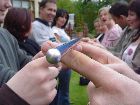
Perfect Square, $69.95The Perfect Square is an easy event that can be very powerful. A blindfolded event represents many of the 'filters' we view the world through. With blindfolds on, communication can be difficult. Interdependence is clear in this activity and group consensus can be difficult to reach, but very important. A glimpse into Perfect Square: Putting the group in a circle, they all reach forward to grab a rope that is laid down in front of them. After putting on their blindfolds, the group must form a perfect square. Once the group feels they have formed the perfect square, they take off the blindfolds to see how close they are. Seemingly easy, this activity is challenging. Ideal For: Problem solving, trust, critical thinking, pure fun, communication. Read more about Perfect Square...
|
||
|
|
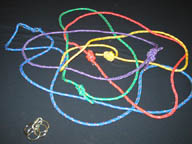
Team Shackles, $79.95Overcome challenges by ‘unlocking’ the compartments in the mind!If people in your organization tend to work in isolation or in ‘compartments’, if information sharing or seeking a co-worker’s counsel is non-existent, then you need Team Shackles. Team Shackles can bring about a paradigm shift in attitudes toward fellow workers. The game demonstrates how the whole team can benefit if there is willingness to seek and give help. It will also build confidence within the group and disprove the notion that some things are impossible. A glimpse into Team Shackles: This exercise has a simple setup but offers a great challenge. Within each team participants are ‘handcuffed’ to each other. The challenge is not only in each pair untangling the Shackles but in the entire team getting disentangling within a given time limit. In this game you will notice some stereo-typical behavior among participants. Although the game requires the entire group to untangle, pairs that have managed to un-cuff earlier than others will usually not offer their help to other team members until time is running out or sometimes not even then. It was not in the 'rules'! The game attempts to correct this behavior and develop a more supportive and helpful attitude among participants. Read more about Team Shackles...
|
||
|
|
Tied
In Knots, $79.95
|
||
|
|
 Cultivate
the twin skills of decision making and consensus building
Cultivate
the twin skills of decision making and consensus building


